
These are some practical advice and exercises I have put together to help clients between sessions.
It is important to have a routine of becoming aware of tension you are holding. If muscles are tense, any injury or trauma is increased and takes longer to heal.
The body is amazing and can adapt to whatever it is put through; your body will adapt to make bad posture feel normal – so, you don’t even realise you are holding tension – until you get an injury;
Unfortunately as we age our body is less able to bounce back. So its important to try to get out of your head sometimes and be more aware of your body and where tension is held.
Caroline Danby, BSc, FBSc, Dips. MFHT, MTRA
Stiff Neck Exercise – for pain in the neck and/or shoulders
Try to keep your head and neck loose. I know it’s difficult as you’ve been holding it in anticipation of pain, but gently do this rolling head exercise….
EMPHASIS IS ON NECK/SHOULDER MUSCLES NOT BEING USED and slow and gentle micro-movements being the key:
- Stand comfortably, and loll/flop your head forward as if your neck has been anaesthetised – stay still and let your head hang.
- Become aware of your neck and shoulders – be conscious of any tension and let it go.
- Become aware of your arms hanging by your sides – release any tension in your arms till they feel heavy. Feel the pull on the rotator cuffs (top of arm/shoulder). BREATHE DEEPLY AND SLOWLY AND RELAX.
- We are going to start to slowly move our head in a circular movement 360 degrees and back to the front again, without using your head or neck at all.
- With feet apart, use your legs/knees or hips in a slow and subtle motion, to help you move (loll) your head all around from front to right side, to the back and round slowly again to the left-side and to the front again – 360o – very very slowly and gently. Remember those hand-games where you had to get the tiny balls into the holes – it would only work if you did it very gently and adjusted the balance/movement? It’s a bit like that.
- DO NOT use your upper body or neck to help move your head. These muscles need to be relaxed or it will be painful.
- VERY gently keep rolling all the way around, very slowly – (you can stop at the back point and sway very slightly from side to side while head is lolling backwards (you may hear/feel crunching sounds in your neck), then very slowly and gently around to the other side and back to the front again. ALL DONE WITHOUT USING YOUR NECK MUSCLES.
- If too sore, stop and try later, but it will not work if you are moving your head around itself or using your neck – you must use every other part of your body to coax your head slowly around.
- Keep checking there is no tension in your neck at all – stop and just let your head hang and practice letting go of all tension, then continue. You can work at your own pace depending on pain levels.
- The general rule being the more painful the area, the slower and gentler your movements must be – or try again when the inflammation has reduced.
- You may need to adjust your position to help ease your head gently around, by subtle movements of your lower body. The more you practice, the easier it will get as you develop a technique that works for you.
Muscles
Often a client will say “I just reached up…, or I was just vacuuming…, etc, when my back just went, and now I cannot move…..” – it wasn’t that last act that caused it but the years of bad posture, held tension or physical muscle strain that went before. Finally it couldn’t take any more and needs to rest.
When a muscle is stretched beyond its normal limits, the “survival reflex” automatically contracts that muscle to protect it from tearing apart.
This ‘myotatic reflex’ (or reciprocal muscle inhibition), is the relaxation response to protect stretched muscles from damage. Here is an exercise to help this:
A gentle exercise to help shoulder pain:
I found that having some slight opposition (to push up against) after the stretch really helps – ie. A low ceiling or door frame to slightly push up against at the point of stretch.
- Find a door-frame or low ceiling that you can comfortably stretch up to that gives a slight opposition (not too far a reach); try a few different places to get the best one for you. You will know when it feels right.
- Push very gently against the opposition (the frame/ceiling) hold for 30 seconds, then relax for 30 seconds while keeping the position (touch, push, touch)
- Do this 30 second gentle stretch with a 30 sec relax, 8 times daily. That’s it!
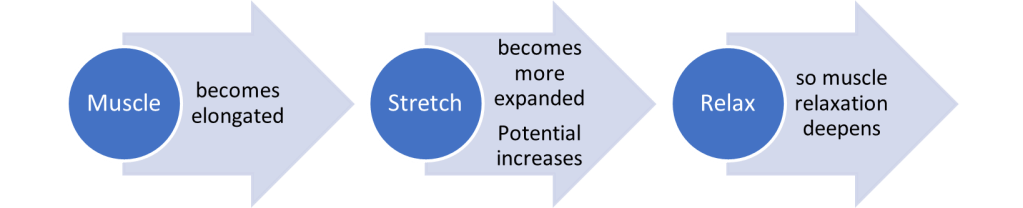
The muscle becomes elongated. The stretch becomes more expanded = The stretch potential increases, so muscle relaxation deepens.
Circulation is also improved in taking toxins away from tired muscles. Muscle tone/relaxation improves in bringing energy into the resurrected body.
Another Useful Exercise for re-learning to let go of tension
- Stand with spine straight, head aligned on top of spine, eyes looking forward.
- Become aware of arms dangling by your side. Try to relax them and feel the pull on your rotator cuff at top of arm/shoulder.
- Concentrate on your breathing – slowly in through your nose and out through your mouth. Feel the rise and fall of your chest and let your shoulders and arms go a little more with each out breath.
- (Imagine a subtle deep sigh in your body with everything letting go with the out breath).
- Gently sway using legs/hips only – not your upper body, as we are trying not to use any muscles there. Slowly build up momentum and let arms flop around – re-learning what relaxed muscles feel like. Do this particularly after heavy lifting, working on computer etc
A Technique to help you become more aware of your body
For those who are always ‘in their heads’, thinking and ruminating – and find it difficult to bring their attention into their bodies and feel the tension held in different areas.
- To distract your mind from wandering – focus on your breath; feel the air being sucked in through your nostrils and out through your mouth.
- As you breath in count from 1-10 slowly, and say the numbers to yourself.
- In your mind’s eye, imagine you are writing out the numbers as you say them
- On the out breath – make it a gentle slow sigh, sending the breath down the body, relaxing as it goes. If you are lying down, imagine with each out breath you are relaxing your shoulders a little more – they are sinking into the bed more and more being pushed down gently with each breath.
- If your mind still wanders, that’s fine – when it happens just gently bring your attention back to your breath and continue again;
- With practice this becomes easier and you will find noticing tension in your body almost effortless. If you are always thinking and ruminating, it will take a while to learn to become aware of your body.
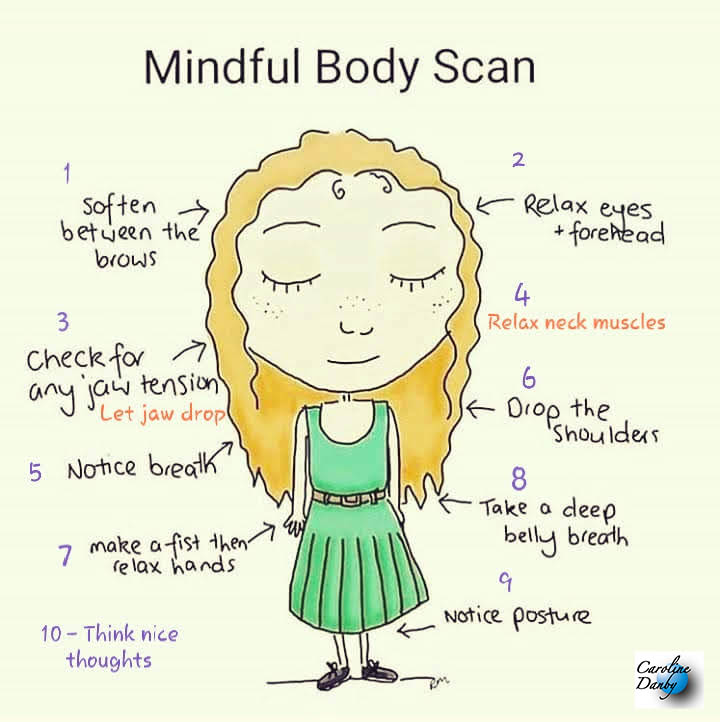
Mindfulness Body Scan
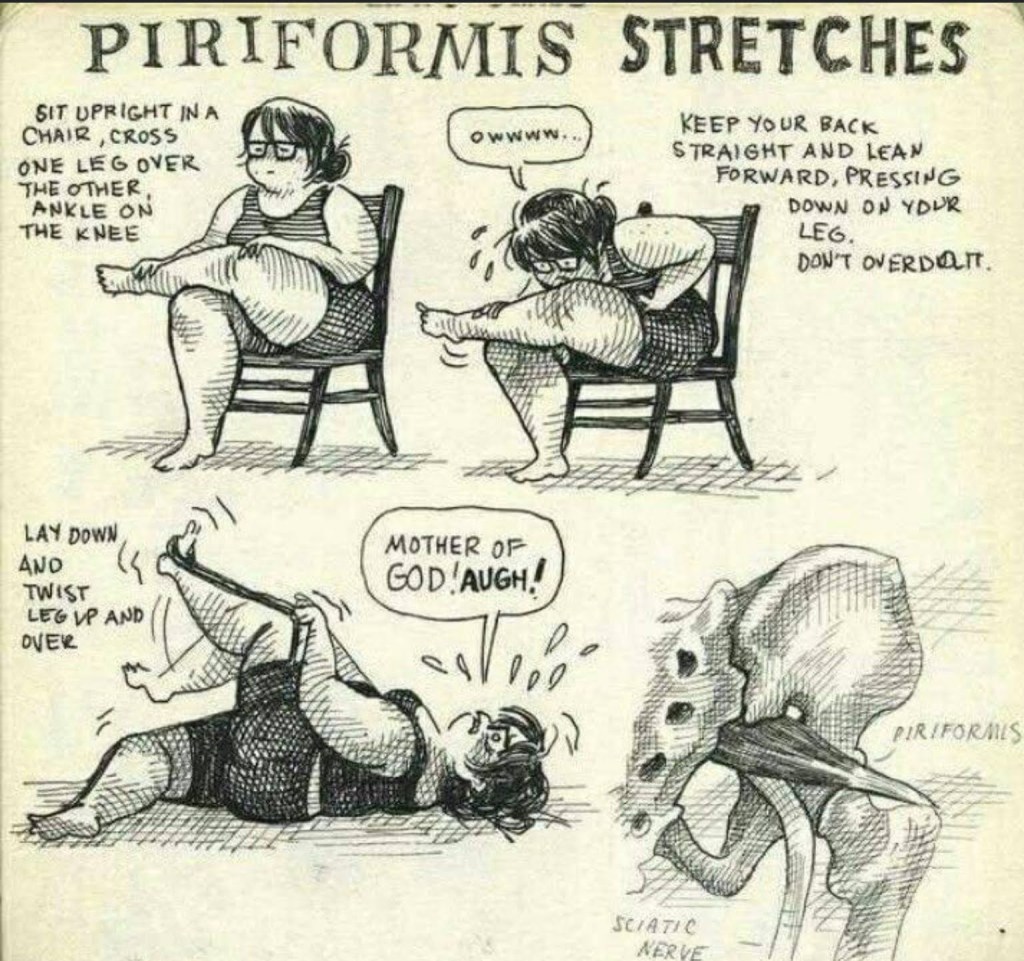
Something to make you laugh – but actually helps lower back pain: be very gentle!
Please ask any questions – I welcome any feedback, especially if it helped you.
Caroline Danby, BSc, FBSc, Dips. MFHT, MTRA
 INTUITIVE HOLISTIC THERAPIST